The client, a B2B education provider, was running a Performance Max campaign that wasn't set up with the right conversion goal. It was optimising for contact page views rather than enquiry form submissions, so an automated bidding strategy had no reliable conversion data to learn from. It was also spreading budget across Display, YouTube, Gmail and other Google channels, when people who are actually looking for this kind of programme search Google for a solution to a specific problem. So I paused it and built a Manual CPC Search campaign from scratch, to stay in control of search terms and ad spend. The account now tracks real enquiries, and over its first five months, the new campaign's cost per click came down from £2.76 in June to £1.63 in October.
Problem
- Performance Max ran from Dec 2025 to May 2026: £4,481 spent, 26,300 clicks.
- Cost per click was very low, at £0.17 on average, but 99% of its conversions were people loading the contact page. The visit alone triggered a conversion, whether or not anyone sent an enquiry.
- In April and May, clicks jumped to over 10,000 a month at under £0.10 each, and conversions rose to 700 to 800 a month. It looked like progress on paper, but none of it could be traced to an actual enquiry.
- Spend was spread across Google channels such as Search, Display and YouTube. This programme serves decision makers in education who are actively looking for training, so an ad interrupting someone mid YouTube video was never going to land. The demand starts with a search, which is why the new campaign is Search only.
- Bottom line: most of the budget was working towards the wrong goals, on channels that didn't suit the audience or their search intent.


Approach
Before touching anything in the Google Ads account, I planned the whole campaign in a spreadsheet: keyword research, negative keywords to block searches with the wrong intent, ad groups and responsive search ads, all mapped out in one campaign overview. That way, everything was ready to go the moment I opened the Google Ads dashboard.
Initial set-up
- Paused Performance Max and built a Manual CPC Search campaign from scratch, with a budget of £500 a month (£16.45 a day).
- Split the campaign into four ad groups by search intent, so each group's keywords, ads and bids match what people are actually searching for.
- Set up conversion tracking in Google Tag Manager. Enquiries and purchases only count when someone reaches the matching thank-you page, and I tested each one before going live.
- Removed the old contact page goals, so the account only counts real enquiries, and nothing is counted twice.
Ongoing optimisation
- Pulled performance reports through Windsor AI, connected to Google Ads as an MCP server, and double checked them in the Google Ads dashboard itself.
- Maximize Conversions was tested on a Google rep's recommendation. Daily clicks fell from around 10 to as low as 3 within days, since the campaign didn't have enough conversion data for automated bidding to work, so I switched it back to Manual CPC.
- Reviewed search terms regularly: added keywords that brought in relevant traffic, paused the ones that spent without converting, and built out the negative keyword list to block research and document searches.
- Adjusted bids by ad group, based on where the spend was going and which searches led to enquiries.
- Rewrote the ads and made every responsive search ad headline unique, so Google can test more combinations.

Result 25 May to 25 Oct 2026
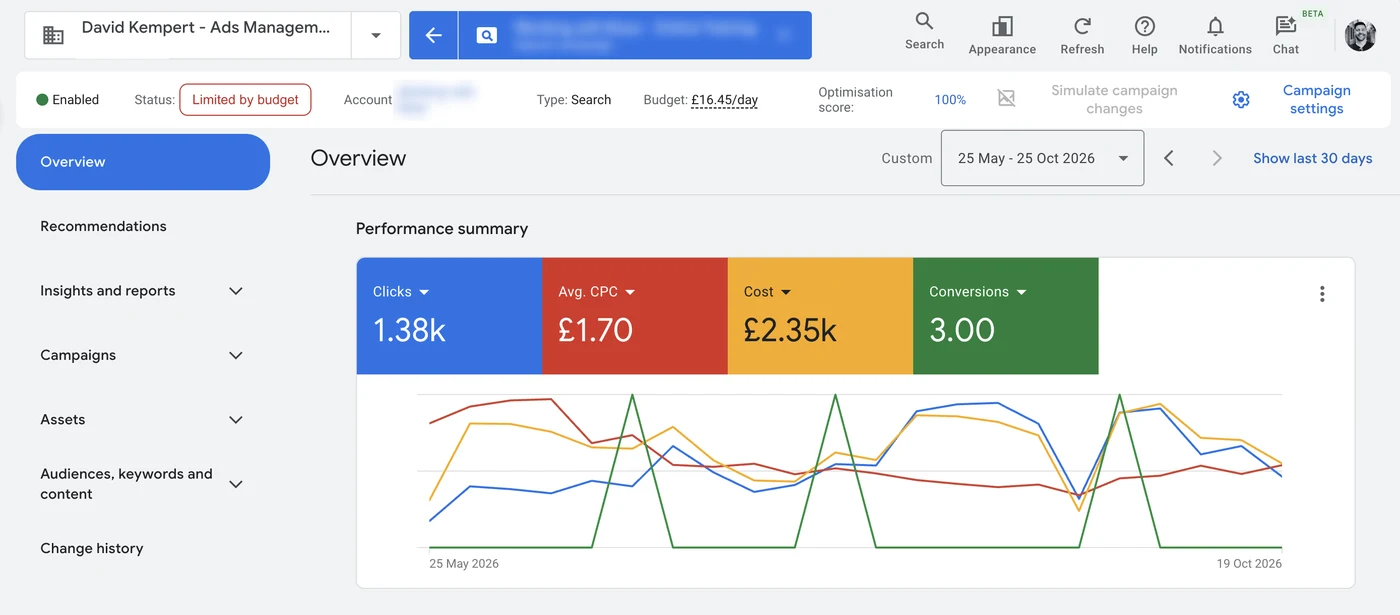
- Conversions went from 1,647, almost all of them contact page loads, to 3 tracked course enquiries. That looks like far fewer on paper, but each one is a real person using the enquiry form, which is the main sales channel for this online training programme.
- The average CPC went down from £2.76 in June to £1.63 in October, a 41% drop. CPC was at its lowest in September, at £1.34.
- Overall: £2,353 spent, 1,384 clicks, 7.7% CTR.
Key takeaways
- A campaign can look like it's working really well, with a low cost per click and high conversion counts, while actually tracking the wrong thing. Getting conversion goals right comes first, before judging any numbers, because they might not be what they seem.
- Automated bidding needs a good amount of conversion data to learn from. With only a few enquiries a month and a brand new campaign, manual bidding kept the campaign more stable and gave me control over every search term and the spend behind it.
- Choosing the right channels matters a lot, especially for a niche programme with a specific search intent. Channels like YouTube and Display can work well for many businesses, but they weren't the right fit here.
"I thoroughly recommend David. He started working for me in April '26 and after just a few months revolutionised many aspects of my online presence. He started by using his considerable knowledge of Google Ads to pause and then rebuild the whole [Google Ads] campaign, increasing CTR and bringing down CPC. He then made subtle but insightful adjustments to my website before then undertaking to build a brand new site for my overall professional brand. He did this quickly and efficiently, bringing a unique blend of technical know-how, design, and a keen understanding of the zeitgeist in marketing. [...] I would be delighted to speak to anyone on a personal basis to further my unreserved recommendation of David."